
Science, literature and global affairs | Updated October 11, 2026
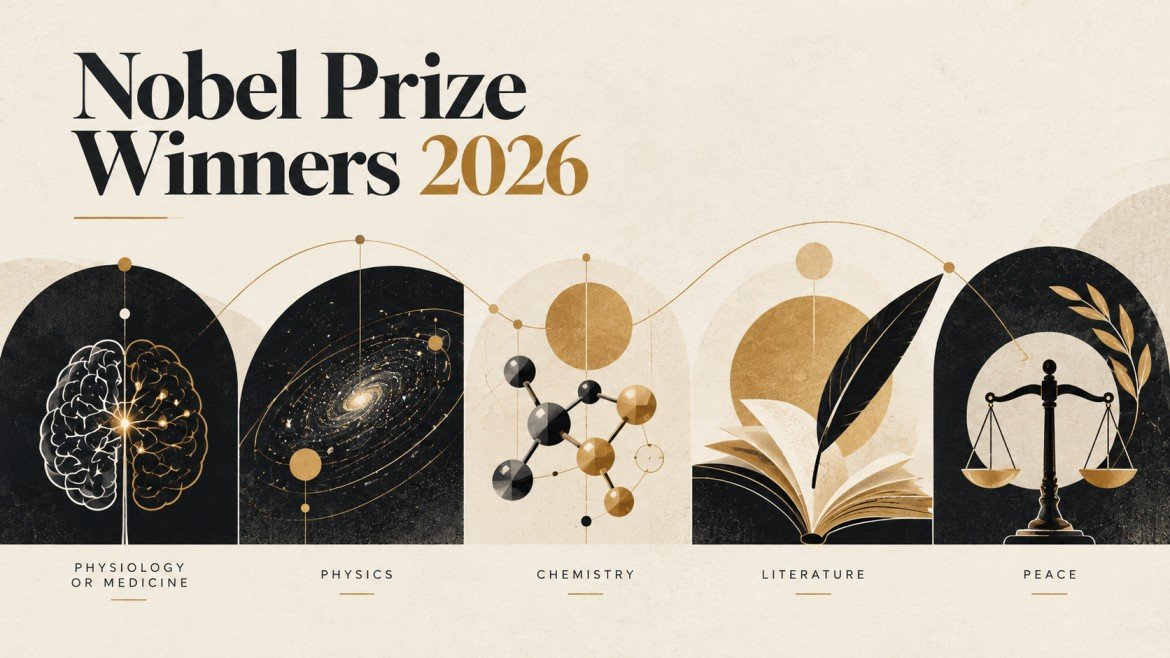
Every year, the Nobel Prizes recognise individuals whose work has changed how we understand the world, from the fundamental workings of the human brain to the laws of the universe and the struggle for international justice. The 2026 awards are no exception, with this year’s laureates making contributions across neuroscience, particle physics, chemistry, literature and human rights.
The common thread running through several of this year’s awards is the power of a new way of looking at an old problem. Scientists have found ways to control brain activity with light, detect elusive particles arriving from distant cosmic environments, and understand how chemical reactions favour one molecular structure over its mirror image. In literature and international affairs, the awards recognise equally distinctive contributions to creative expression and the rule of law.
1. Nobel Prize in Physiology or Medicine 2026
Announced October 5
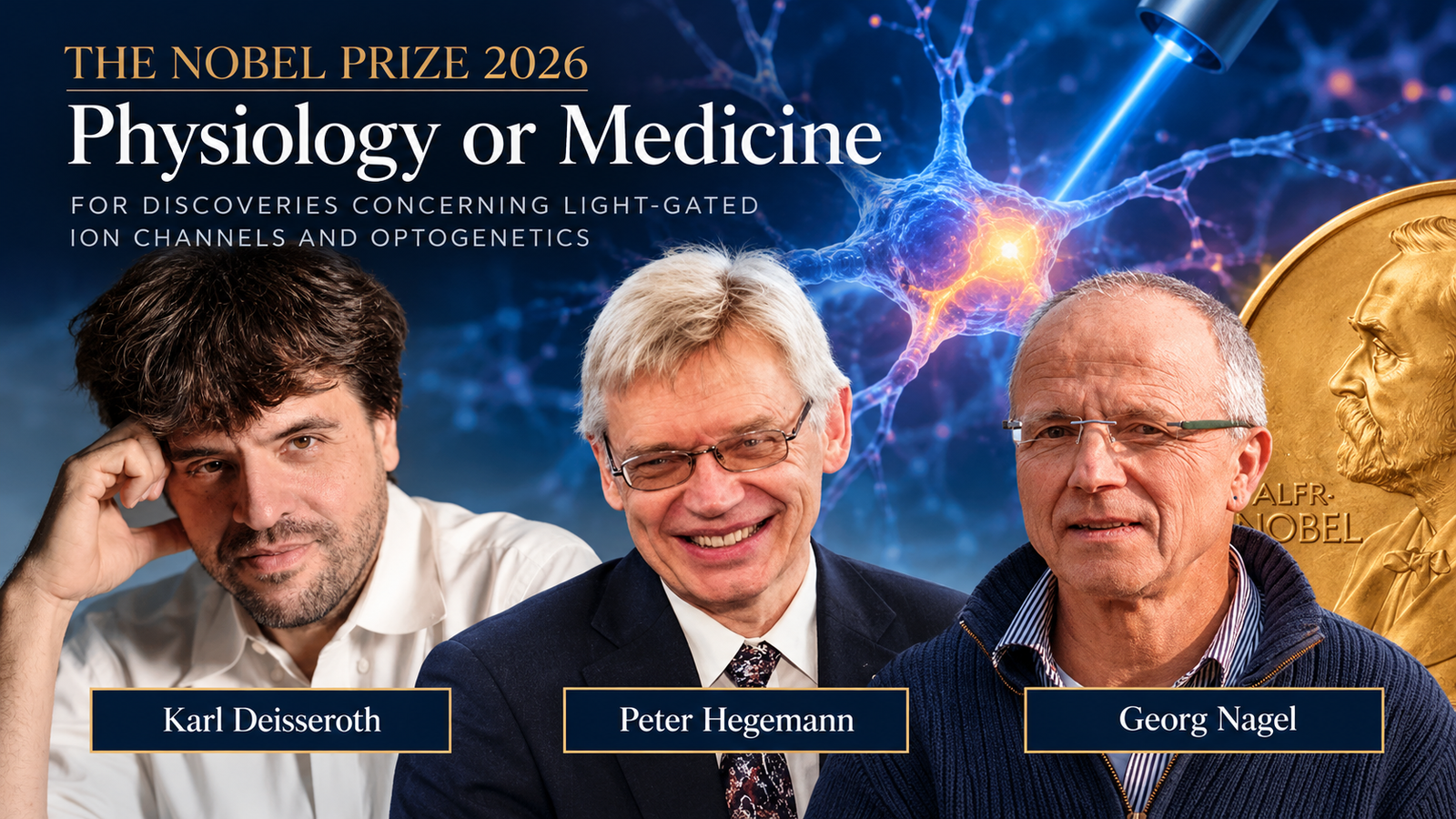
Winners: Karl Deisseroth, Peter Hegemann and Georg Nagel
Awarded for discoveries concerning light-gated ion channels and optogenetics.
The 2026 Nobel Prize in Physiology or Medicine recognises a breakthrough that has transformed how scientists investigate the brain: the ability to control the activity of individual nerve cells using light.
Karl Deisseroth of the United States and German scientists Peter Hegemann and Georg Nagel helped establish the foundations of optogenetics, a technique that combines genetic engineering with optical stimulation to manipulate specific cells.
Why were they chosen?
The story began with research into Chlamydomonas, a microscopic green alga that responds to light. Hegemann investigated how the organism senses light, while Nagel helped identify and characterise channelrhodopsin-2, a light-sensitive protein that acts as an ion channel. Such proteins allow charged particles to cross cell membranes when activated by light.
Deisseroth subsequently demonstrated how light-sensitive proteins could be used to control nerve cells in mammalian brains. Researchers could now activate or inhibit selected neurons and observe how the brain responded, rather than merely recording neural activity and guessing which cells caused a particular effect.
Why it matters
Optogenetics has become an important tool in neuroscience, helping researchers investigate movement, memory, sleep and neurological disorders. It could also inform future treatments for conditions such as epilepsy, Parkinson’s disease and certain forms of blindness. However, these potential therapies remain at different stages of research and development.
The award recognises the creation of a research tool that has opened new avenues for understanding the brain, not a claim that scientists have already found cures for these diseases.
My two bits
The field took off when Karl Deisseroth demonstrated how light could be used to turn certain neurons in the brain on or off. Of course, the technique was first tested in animal models. Now hopefully we won’t have to cut people’s brains open to study them. But there are challenges when you hit a part of the brain with light; other parts can also get activated. And how many times can you really shine light on a patient’s brain without interfering with its function? In some approaches, small openings in the skull are needed to deliver light deep inside the brain. And what happens if the light damages the very neurons you are trying to study?
2. Nobel Prize in Physics 2026
Announced October 6
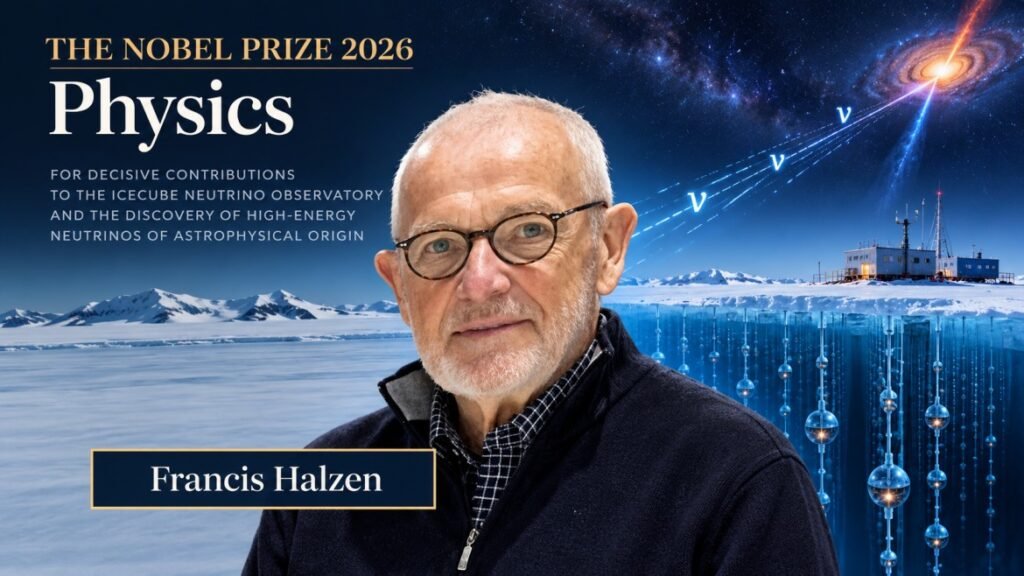
Winner: Francis Halzen
Awarded for decisive contributions to the IceCube Neutrino Observatory and the discovery of high-energy neutrinos of astrophysical origin.
Physics laureate Francis Halzen has helped open a new window into the universe by making it possible to study high-energy neutrinos originating from cosmic sources.
Neutrinos are subatomic particles that interact extremely weakly with matter. Trillions pass through our bodies every second without producing any noticeable effect. Their ability to travel enormous distances with relatively little interference makes them valuable messengers from the universe’s most energetic environments.
Why was he chosen?
Halzen championed the idea of turning the Antarctic ice sheet into a giant particle detector. This vision became the IceCube Neutrino Observatory, which uses thousands of light sensors embedded deep in the ice near the South Pole.
When a neutrino occasionally interacts with matter in the ice, it can produce charged particles that emit faint flashes of light. IceCube detects these flashes, allowing scientists to reconstruct the particles’ paths and investigate their possible cosmic origins.
The observatory has helped establish high-energy neutrino astronomy as a means of investigating distant astrophysical phenomena, including environments associated with powerful cosmic accelerators.
Why it matters
Traditional astronomy relies heavily on light, including radio waves, visible light and X-rays. Neutrino astronomy adds another way to study the universe. Because neutrinos can escape dense cosmic environments, they may reveal information that conventional telescopes cannot easily provide.
Halzen’s Nobel Prize recognises the scientific vision and contributions that made this new observational approach possible.
My two bits
This is consequential because neutrinos interact so weakly with matter that they can travel across enormous distances without being stopped. They don’t simply come from black holes, but detecting them can help us investigate some of the most energetic events in the universe, including activity around black holes at the centres of galaxies. Who knows what this might tell us about the universe and our origins?
It was quite a novel idea to capture these neutrinos in miles of ice. The ice is transparent, and when a neutrino interacts with matter, the charged particles it produces can create a faint blue light. IceCube’s sensors pick up these flashes. Turning a vast stretch of Antarctic ice into a particle detector is a rather unusual way to do astronomy, to put it mildly.
3. Nobel Prize in Chemistry 2026
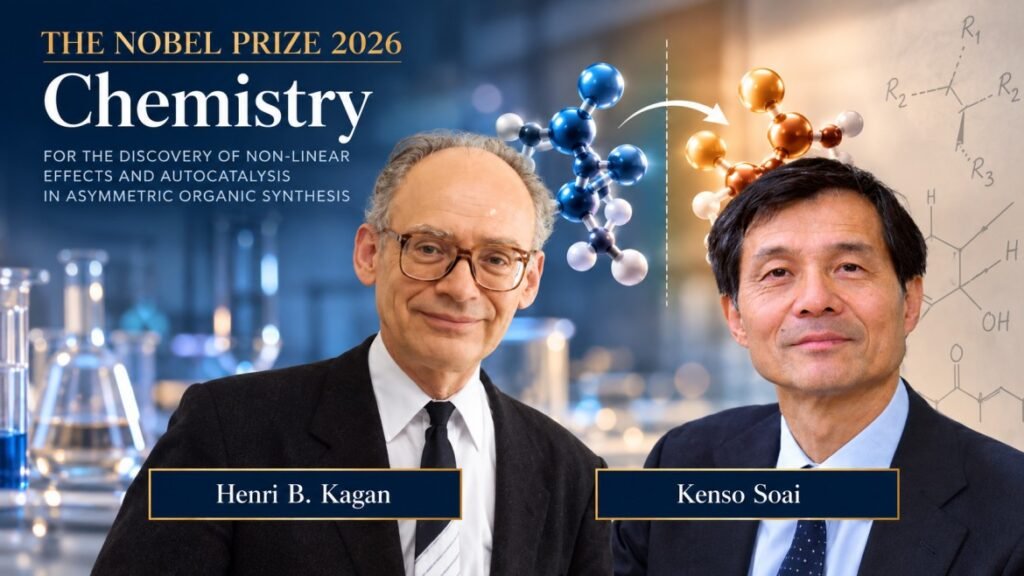
Announced October 7
Winners: Henri B. Kagan and Kenso Soai
Awarded for the discovery of non-linear effects and autocatalysis in asymmetric organic synthesis.
Chemistry’s 2026 Nobel Prize addresses a problem that sounds deceptively simple: how can chemists make a reaction produce predominantly one version of a molecule when two mirror-image versions are possible?
These molecules exhibit a property called chirality. Like a left hand and a right hand, the two forms are mirror images but cannot always be superimposed on each other. This distinction matters because biological systems can respond very differently to each form.
Why were they chosen?
Henri B. Kagan made influential contributions to asymmetric synthesis, helping chemists develop reactions that favour one molecular form over another. Kenso Soai’s research demonstrated how a reaction could amplify a small initial imbalance between mirror-image forms through autocatalysis, in which a reaction product helps promote the formation of more of itself.
Their work helped explain how molecular handedness can be generated and amplified during chemical reactions. It also advanced scientific understanding of how a preference for one molecular form can emerge, a question relevant to the origin of life’s characteristic molecular asymmetry.
Why it matters
Molecular handedness is critical in pharmaceutical chemistry. Two mirror-image forms of a compound can differ in their biological activity, interactions and safety profiles. Methods that selectively produce a desired form can improve the efficiency and control of chemical manufacturing.
The research also has wider significance for understanding why living organisms use particular molecular forms in many essential biological processes.
The award is therefore about more than producing better chemicals. It recognises discoveries that connect practical synthesis with a fundamental question about the chemistry of life.
My two bits
It’s like the left hand doesn’t know what the right hand is cooking. One structure of a compound can be medicine; turn its hands, and it can behave really differently in the body. In some cases, one version may have the desired medicinal effect while the other has unwanted effects. Could be important, this one, if we use it well.
4. Nobel Prize in Literature 2026
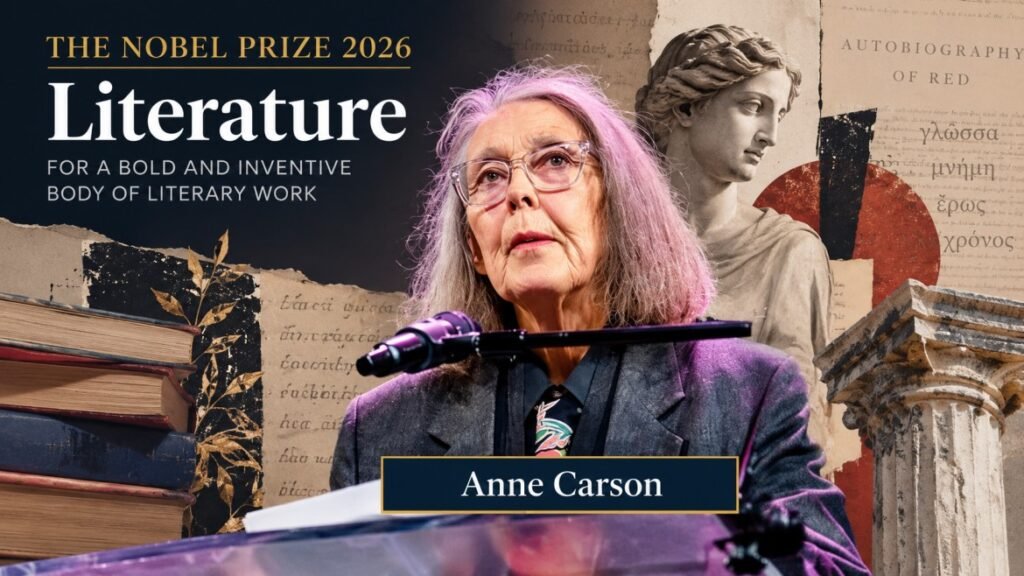
Announced October 8
Winner: Anne Carson
Recognised for a bold and inventive body of literary work.
Canadian poet, essayist and translator Anne Carson has won the 2026 Nobel Prize in Literature for a body of work that challenges conventional distinctions between poetry, prose, drama and translation.
A former classics scholar, Carson frequently draws on ancient Greek literature and philosophy while exploring contemporary questions of love, identity, loss and human relationships. Her writing often combines scholarly references with experimental forms, unusual structures and strikingly economical language.
Why was she chosen?
Carson’s work does not fit neatly into conventional literary categories. She moves between poetic fragments, essays, dramatic dialogue and reinterpretations of classical texts, using these forms to create new ways of approaching familiar human experiences.
Works such as Autobiography of Red demonstrate her ability to rework ancient material into a distinctly contemporary literary experience. Her translations and adaptations similarly bring classical texts into conversation with modern readers.
The Swedish Academy recognised the originality and inventiveness of her literary output, particularly its engagement with classical traditions and its willingness to experiment with form.
Why it matters
Literature can preserve cultural memory while also questioning how societies understand themselves. Carson’s work shows that classical texts need not remain confined to academic study. They can be reinterpreted to explore contemporary emotions, relationships and moral questions.
Her Nobel Prize celebrates an approach to writing in which intellectual rigour and artistic experimentation reinforce each other.
My two bits
Well, this one has been heavily criticised, as one of her poems doing the rounds on X is apparently enough for some people to dismiss all her work. I read her translation of Fragments of Sappho and then thought I’d better learn Greek, because the translation was not cutting it for me. Too many parentheses to show that the parchments were missing words took me away from the content.
Also, I did not understand what the hoopla around Sappho is all about. Perhaps something gets lost when you read fragments of an ancient poet through a modern translation. Perhaps I am missing something. But that was my experience of reading it, and a Nobel Prize is not supposed to mean that we must automatically like everything an author has written.
5. Nobel Peace Prize 2026

Announced October 9
Winner: Navanethem “Navi” Pillay
Awarded for her efforts to promote peace and international law.
The 2026 Nobel Peace Prize recognises Navi Pillay, a South African jurist and former United Nations High Commissioner for Human Rights, for her longstanding contribution to human rights, international justice and accountability.
Pillay’s career has been shaped by the struggle against racial discrimination and the development of international legal institutions designed to hold individuals accountable for serious crimes.
Why was she chosen?
Born in Durban in 1941, Pillay grew up under apartheid, South Africa’s system of racial segregation and discrimination. Her subsequent legal career took her into international justice, including service as a judge and president of the International Criminal Tribunal for Rwanda.
She also served as the UN High Commissioner for Human Rights from 2008 to 2014. Since 2019, she has served as an ad hoc judge at the International Court of Justice in the case brought by The Gambia against Myanmar under the Genocide Convention. Her work has focused on protecting fundamental rights, strengthening legal accountability and ensuring that violations of international law receive serious scrutiny.
The Norwegian Nobel Committee recognised her efforts to promote peace and international law, highlighting the importance of accountability and respect for the international legal order.
Why it matters
Pillay’s award highlights the relationship between international justice and peace, particularly at a time when the authority of international institutions and the enforcement of international law face considerable challenges.
My two bits
Trump isn’t pleased with this one, to put it mildly!
6. Nobel Prize in Economic Sciences 2026
Scheduled for October 12, 2026
Winner and award citation: Not yet announced as of October 11.
The economics laureate cannot yet be included in a factual list of this year’s winners. The award formally known as the Sveriges Riksbank Prize in Economic Sciences in Memory of Alfred Nobel is announced separately from the five traditional Nobel categories discussed above.
The economics award typically recognises research that has significantly advanced our understanding of how economies function. Past awards have covered subjects ranging from financial crises and labour markets to poverty, institutions and decision-making.
What do the 2026 Nobel Prizes tell us about the direction of research and society?
Three broader themes emerge from this year’s announced awards.
1. Scientific progress often begins with a new way to observe a problem
Optogenetics allows researchers to manipulate selected neurons with light, while IceCube uses Antarctic ice to detect elusive particles from space. Both breakthroughs emerged from finding new ways to investigate phenomena that had previously been difficult to study directly.
2. Fundamental research can have applications far beyond its original purpose
Work on light-sensitive proteins in algae helped transform neuroscience. Research into molecular asymmetry has influenced how chemists approach the synthesis of pharmaceuticals and other compounds. These examples demonstrate why basic research can be valuable even when its practical applications are not immediately apparent.
3. Progress is not measured by technology alone
The Literature and Peace prizes recognise contributions that operate through different mechanisms. Anne Carson expands the possibilities of literary expression, while Navi Pillay’s work emphasises the role of law and accountability in building lasting peace. Together, these awards underline the continuing importance of culture, institutions and human rights alongside scientific discovery.
Conclusion
The 2026 Nobel laureates have been recognised for work that expands the boundaries of human understanding. Their contributions range from revealing how nerve cells can be controlled with light and detecting particles from distant cosmic environments to advancing chemical synthesis, reinventing literary forms and strengthening international justice.
Their achievements also demonstrate that progress rarely comes from a single breakthrough in isolation. It often builds on years of research, collaboration and ideas that initially appear disconnected from practical problems.
The Nobel Prizes serve as a reminder that the most consequential discoveries are not always the most immediately visible. Sometimes, they begin with a microscopic alga, a detector buried in Antarctic ice, a molecule’s mirror image or a question about how society should uphold justice.



Leave a Reply