

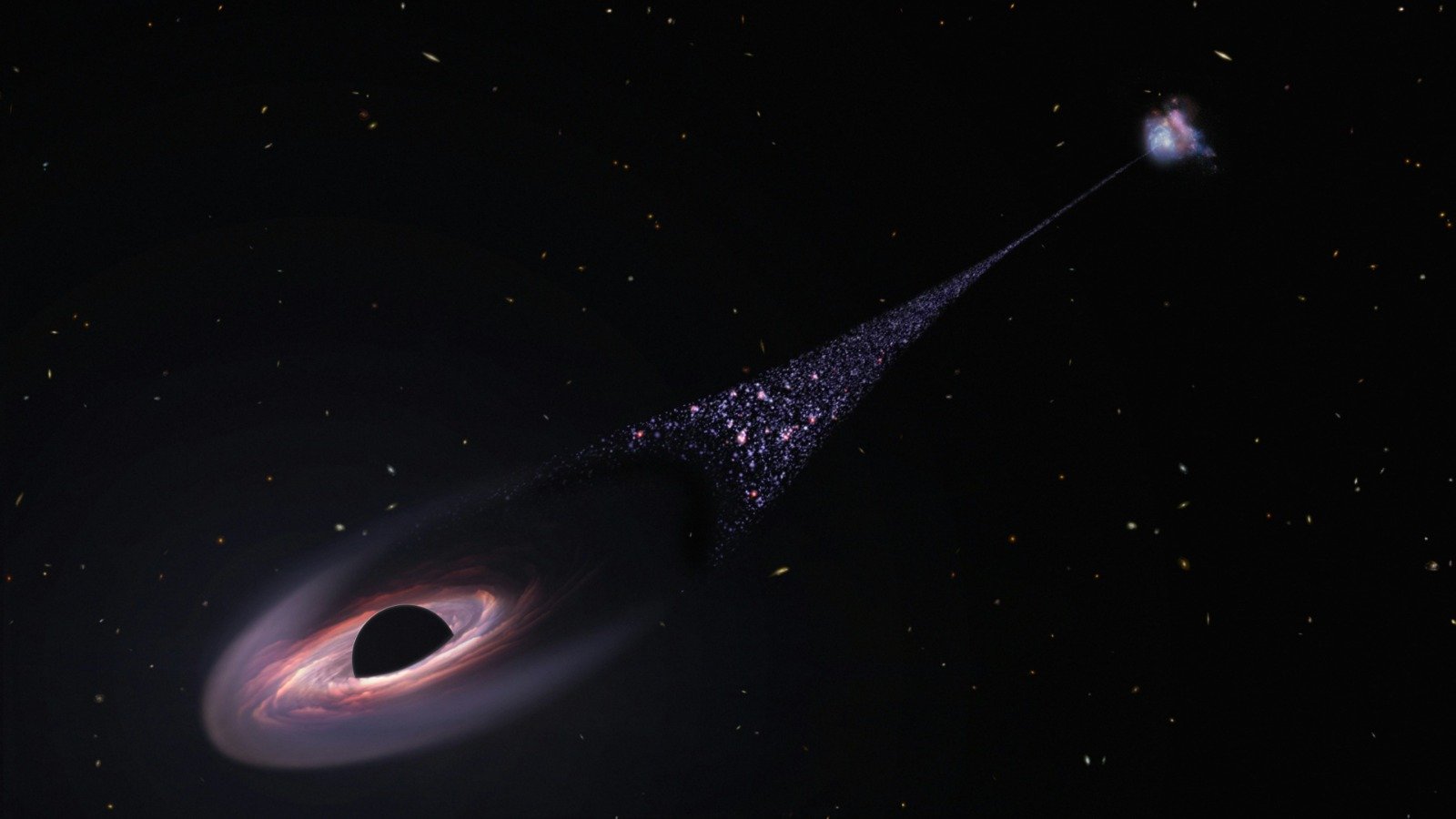
We’ve always wondered what black holes look like, and what it would mean to fall into one. Are they pitch black, a patch of pure darkness? Is there a pit that pulls you in as you stare into the abyss?
Turns out, we don’t have to imagine anymore. In 2019, astronomers released the first-ever photo of a black hole, the giant one at the center of a galaxy called M87. In 2022, they followed it up with our own Milky Way’s black hole, Sagittarius A. Both images look like a glowing, fiery ring around a dark center. That’s not the darkness you’d expect. It’s a donut of light.
Contrary to popular belief, black holes are surrounded by some of the brightest light in the universe. The region inside the event horizon traps all light, but just outside it, gas and dust spiral inward in a swirling accretion disk. Friction and magnetic forces heat this material to millions of degrees, and it glows fiercely. The hole itself is dark, but its surroundings are anything but.
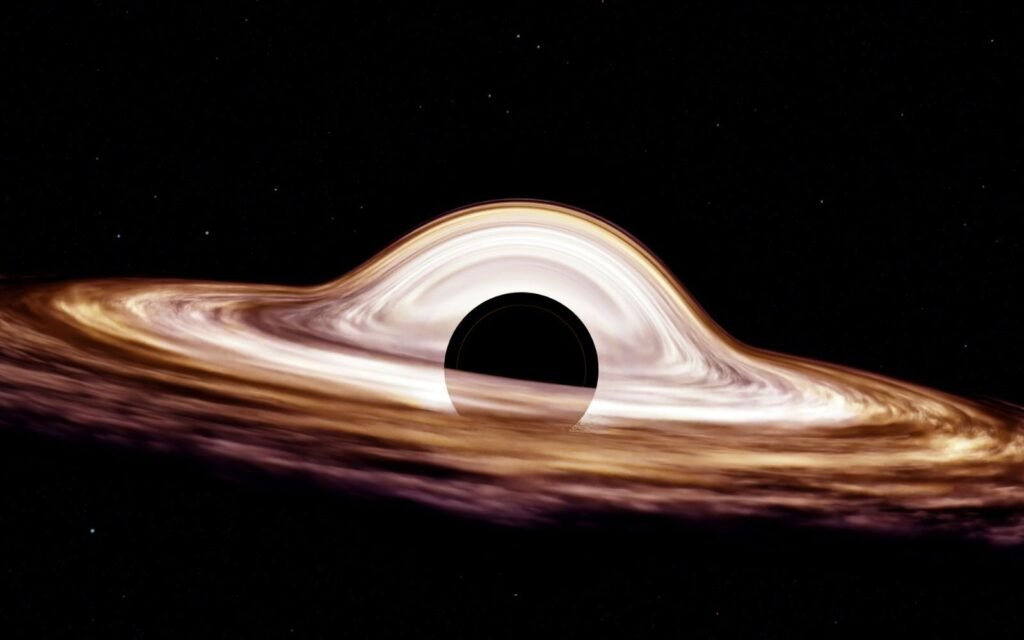
And here’s a twist: even the dark part isn’t perfectly black. In the 1970s, Stephen Hawking showed that quantum effects should make black holes leak a tiny bit of radiation, now called Hawking radiation. Over unimaginably long timescales, this makes them slowly shrink. Don’t go looking for it, though. For real black holes it’s far too faint to detect, and we’ve never observed it directly. But in theory, even the darkest thing in the universe has a faint glow.
They aren’t really “holes” either. A black hole isn’t a gap in space. It’s a region where an enormous amount of mass is packed into a tiny volume, so gravity is strong enough that the escape velocity exceeds the speed of light. Nothing, not even light, can get out.
That also clears up a big myth: black holes don’t “suck things in” like cosmic vacuum cleaners. From a distance, a black hole’s gravity is just like that of any other object with the same mass. If the Sun were magically swapped for a black hole of the same mass, Earth would keep orbiting exactly as it does now. It would get very cold and very dark, but it wouldn’t get pulled in. You only get into trouble if you venture really close.
Supermassive black holes sit at the centers of most large galaxies. Our own Milky Way has Sagittarius A*, about four million times the mass of the Sun. Stars near the galactic center orbit it, while the rest of the galaxy, including our Sun and Earth, is held together by the combined gravity of all its stars, gas, and dark matter.
So what happens if you do get close to one? Space and time themselves warp around it. A faraway observer would see your clock slow down, and you would appear to creep toward the event horizon and fade without ever quite crossing it. But from your own perspective, time flows normally, and you cross the horizon in a finite amount of time.
Once inside the event horizon, there’s no turning back. Every possible path leads toward the center, the singularity. Gravity also pulls harder on your feet than your head, stretching you into a long thin strand, a process physicists call spaghettification. For a stellar-mass black hole, this happens before you even reach the horizon. For a supermassive one, the tidal forces at the horizon are so gentle that you wouldn’t feel anything special as you crossed it. The stretching would come later, deeper inside.
What happens at the very center is a mystery. The singularity is the point where our current physics stops working, and figuring out what’s really going on there is one of the biggest open questions in science.
So let’s go back to where we started. Black holes aren’t black: they’re wrapped in some of the brightest light in the cosmos, and even the dark center is predicted to glow faintly. And they aren’t holes: they’re incredibly dense objects, not bottomless pits in space. The next time you picture one, don’t imagine an endless void. Picture a glowing ring of fire around a dark center, and remember that we’ve only just started to see what they look like, and there’s still plenty we don’t understand









Leave a Reply