

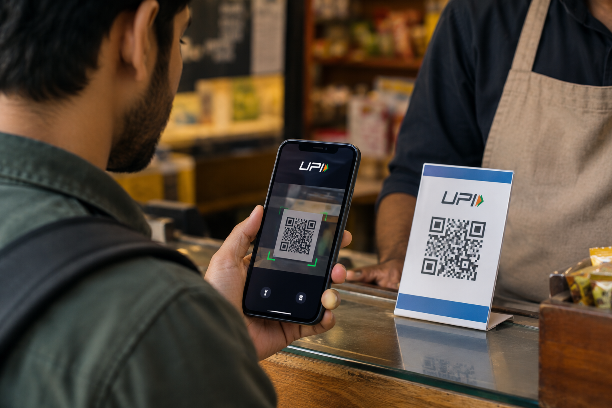
For six years, UPI ran on a simple, radical promise: completely free digital payments, for everyone, every time. That era ends on October 15, 2026.
The National Payments Corporation of India (NPCI) has reintroduced a Merchant Discount Rate (MDR) — a 0.4% fee — on person-to-merchant UPI transactions above ₹2,000. The fee is capped at ₹300 for payments of ₹75,000 or more, and it’s paid by merchants, not customers. NPCI says the money will go toward UPI infrastructure, cybersecurity, and long-term sustainability of the ecosystem.
On paper, this sounds narrow. In practice, it’s reopened a debate India thought it had settled back in 2020: does digital payment infrastructure need to charge someone to survive, and if so, who?
The exemptions are doing a lot of work
The policy is carefully carved to protect the transactions that make UPI ubiquitous. Payments of ₹2,000 or less stay free. Person-to-person transfers stay free. Small merchants processing under ₹1 lakh a month through UPI QR codes are exempt entirely. Railways, telecom, insurance, and fuel get a flat ₹5 charge instead of a percentage.
The result: NPCI data suggests roughly 95–96% of UPI transactions by volume won’t be touched at all. Your morning chai, the auto fare, the kirana store bill — none of it changes.
But value tells a different story
Here’s the catch: transactions above ₹2,000 account for roughly 65% of UPI’s total transaction value, even though they’re a small slice of volume. This is exactly where the money — and the incentive to avoid the fee — lives.
It’s also, unhelpfully, exactly the kind of purchase concentrated in the festive season that just kicked off: electronics, appliances, jewellery, larger retail bills. The Retailers Association of India has flagged this timing specifically, warning that thin-margin merchants may start steering big-ticket buyers toward cash rather than absorb even a 0.4% hit.
Former BharatPe CEO Ashneer Grover put it more bluntly, predicting merchants could quietly ask customers to cover the difference — leaving shoppers to either pay more or just pull out cash instead. Former UIDAI chief R.S. Sharma has made the structural case against the whole approach: UPI’s zero-cost model, he argues, is why it reached small merchants and low-value transactions in the first place, and taxing it now risks undoing that advantage.
Petrol pumps: the sharpest edge of the story
Fuel is one of a handful of sectors — alongside telecom, insurance, and railways — that gets special treatment under the new framework. Instead of the 0.4% rate, UPI fuel payments above ₹2,000 attract a flat ₹5 MDR. NPCI frames this as a concession: a percentage-based fee on a full tank would cost far more than ₹5, so the flat rate is meant to protect pump operators.
Dealers aren’t buying it. Petrol pump associations are pushing for a full exemption, not a discount, and their argument is structural rather than just about margin. Retail fuel prices and dealer commissions are fixed by Oil Marketing Companies — a pump owner can’t raise prices or absorb costs the way an ordinary retailer might. Every rupee lost to MDR simply comes out of an already thin, fixed commission. Some dealer federations have threatened to stop accepting UPI altogether for payments above ₹2,000 if no exemption is granted, and have pointed to 2016 as precedent: after demonetisation, fuel retailers were exempted from MDR entirely, with the cost absorbed by the oil companies instead.
This is what makes petrol pumps different from the rest of the “high-value transactions” conversation. A big electronics or jewellery purchase is occasional. A fuel bill over ₹2,000 is routine — it’s what most car and bike owners pay every time they fill up. If pumps do go cash-only above the threshold, it wouldn’t be a seasonal blip like festive shopping; it would be a daily reality at forecourts across the country.
So, is cash actually coming back?
Probably not as a wholesale shift — the exemptions were built specifically to protect UPI’s everyday, high-frequency use case, and the Finance Ministry has been quick to point out that 96% of transactions won’t feel a thing.
But at the high-value end, a real squeeze is plausible. Watch for three patterns as October 15 approaches: big organized retailers quietly absorbing the cost, smaller shopkeepers softly nudging big-ticket buyers toward cash, and — in the most price-sensitive corners of retail — genuine reversion to cash for large purchases.
The festive season, timed almost exactly with the new rule, is an accidental stress test. If UPI usage on big purchases holds steady through Diwali, the policy will likely be judged a success. If cash quietly creeps back into higher-value counters, the RAI’s warnings will have been the more accurate read.










Leave a Reply