

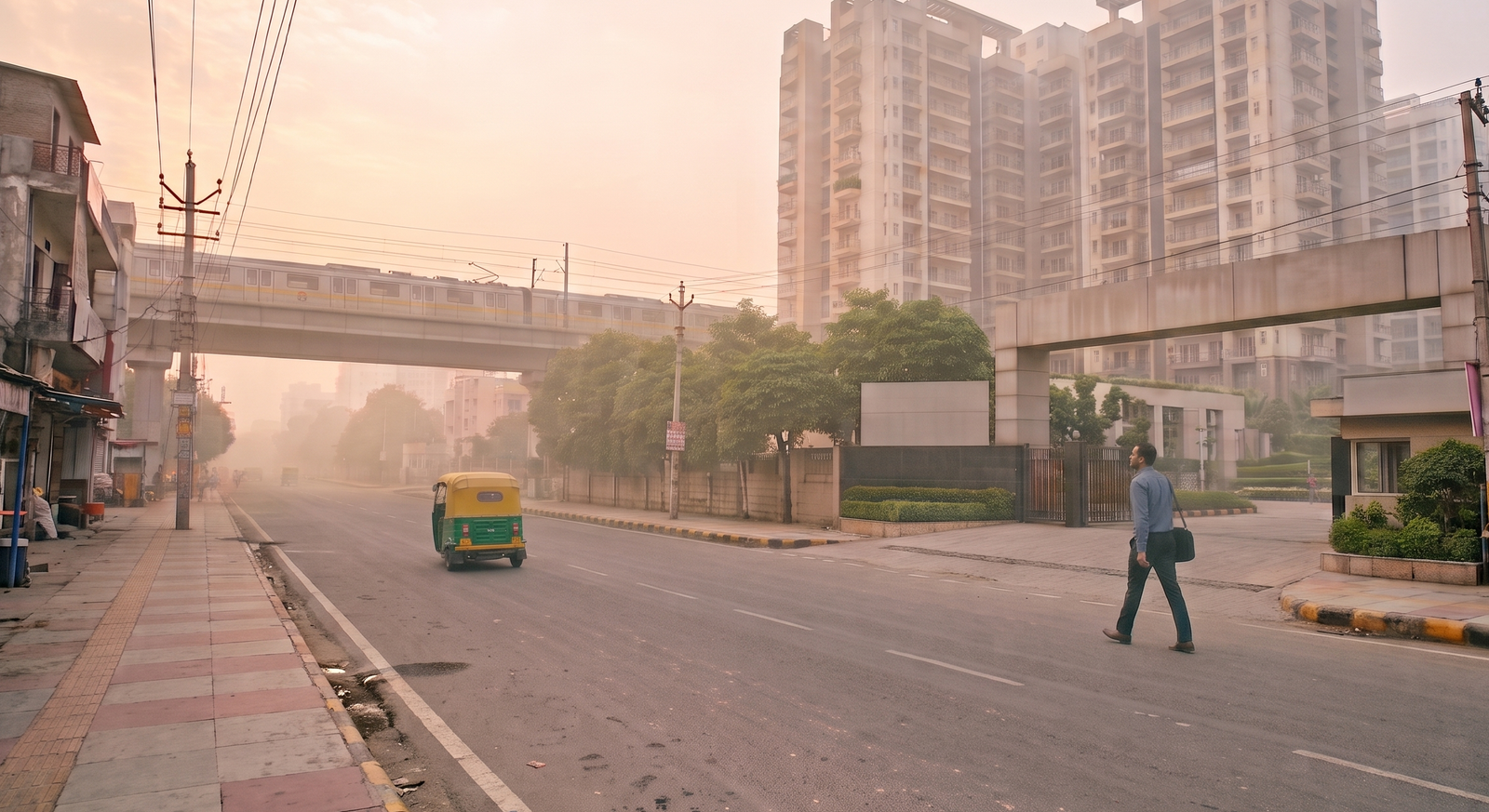
Imagine a man who has been living in Delhi for 20 years. He has been constantly working for that duration, moving around from one rented house to another, but not able to buy a flat. This is the dilemma of the common man.
Suppose he started earning ₹20,000, 20 years ago. Now he is earning ₹85,000. His salary has increased by 3.5x, while the cost of living has grown substantially due to inflation over those two decades. Every year he thinks about owning his own home, but then he looks at a modest ₹35 lakh flat, calculates the EMI and the risk of what if he loses his job, and so never buys the flat.
The price of real estate in major Delhi-NCR corridors has, in some cases, compounded at roughly 10% to 12% annually over the past decade, with some of the fastest-growing corridors delivering around 12% to 15% annualised appreciation. His income, meanwhile, grew by roughly 7.5% annually. In that time he had to take care of his living expenses as he got married and had children. So the cost of living increased simultaneously.
To buy even a basic ₹35 lakh entry-level home, he needs a down payment of roughly ₹7 lakh in cash, leaving him with a ₹28 lakh home loan. At around 8.5% interest over 20 years, the monthly loan installment would be nearly ₹24,300—eating up nearly 29% of his take-home pay on an ₹85,000 salary while trying to feed a family in Delhi. And that is before he pays for children’s education, transport, healthcare, utilities and everything else that comes with raising a family.
The problem is not simply that the man did not earn enough.
Twenty years ago, ₹20,000 was the income of a young person. Today, ₹85,000 may be the income supporting an entire family. His salary has multiplied, but so have the number of things that salary has to pay for. Marriage, children, education, healthcare, transport and rent have all arrived between the first ₹20,000 and the present ₹85,000.
His income increased, but it was never allowed to compound into wealth.
The real estate reports paint a rosy picture, saying that there has been a flight to quality, as luxury real estate sales have increased. Apartments priced over ₹1 crore accounted for 62% of residential sales across the top eight cities in the first half of 2025, according to JLL.
Meanwhile, the affordable end of the market is shrinking. In NCR, homes priced below ₹40 lakh accounted for only 11% of new launches in 2024, according to ANAROCK.
So people will find it hard to ignore the fact that this is a K-shaped economy where even top earners struggle to buy property. So who is buying them?
A high-earning couple, people with generational wealth, and people who are flipping properties or earning massive rents from them.
Boomers didn’t have this problem in the same way; those who bought property decades ago entered the market at much lower prices and have since benefited from decades of appreciation. Generation X somehow managed, while Generation Y was doomed from the beginning, while Gen Z and Gen Alpha are not even playing the game.
The problem is that home ownership requires accumulated capital, not merely income. A person earning ₹85,000 can perhaps afford the EMI, but accumulating the down payment, transaction costs and an emergency cushion requires years of surplus income. If rent and family expenses consume that surplus, a person can work for 20 years and still find himself standing outside the property market.
So our common man from the beginning of the article, will he be able to buy that flat in Delhi or will he go to his hometown in UP when he grows old and lives there peacefully on his land?
Even if he buys land in Delhi, he will stay in fear of losing his job; if he is renting, he can always pack his bags and leave even if the job market worsens. Surely he will have to shift his kids to the village or nearby town school, but he will be debt-free.
He may never own the Delhi home he spent his life dreaming about.
But perhaps he will own something else: the freedom to leave.
Somehow this is debilitating yet freeing.













Leave a Reply